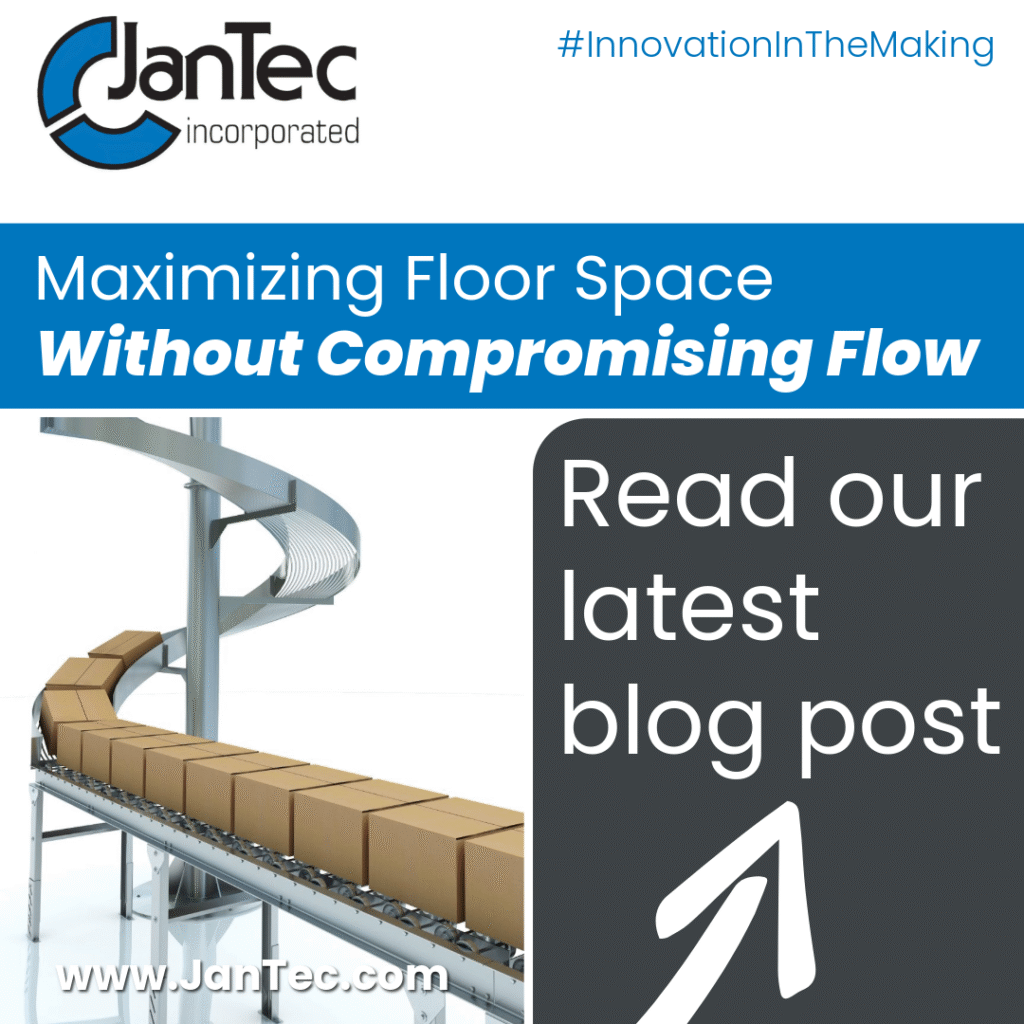
A power turn conveyor is not simply a curved section between two straight conveyors. It is a performance point where product direction, belt tracking, transfer geometry, load, line speed, and available floor space all meet. When that point is not matched to the application, small disruptions can become repeated slowdowns. JanTec engineers each turn conveyor around the product and operating conditions so the equipment supports tight transfers and reliable flow instead of creating another compromise.
Why the turn conveyor can define line performance
A turn conveyor must change direction while maintaining stable product movement and a clean transition to the next section. Centerline radius, bed width, degree of turn, pulley or nose-roller diameter, belt selection, frame construction, and the geometry of the upstream and downstream conveyors all influence the result. Selecting a standard curve by width and angle alone can leave an integrator or end user with an unnecessary gap, an awkward footprint, or a transfer that needs constant operator attention.
JanTec approaches the power turn as part of the full conveyor layout. The objective is not only to make the unit fit. It is to align the turn, transfer interface, and adjoining equipment so the product can continue moving at the required pace.
Tight transfers start with the right power turn
Small, delicate, unstable, or closely spaced products place more demand on the transfer point. The PRN Power Turn uses a pinch-roll drive that minimizes pressure at the conveyor ends and distributes movement across the carrying and return belting. This allows dynamic nose rollers as small as 3/8 inch for applications that need a tighter product transfer. Stainless-steel washdown configurations and removable nose bars are also available for selected applications where cleaning access and belt changes matter.
A straight conveyor before or after the turn also affects transfer performance. JanTec Straight Series conveyors can be configured with nose rollers or a static knife edge to reduce the gap. Looking at the power turn conveyor and straight conveyor together helps prevent one section from solving a problem that the next section recreates.
Match PRN, PTM, and Taco Turn options to the application
Not every application prioritizes the smallest transfer. Some operations need rugged construction, high throughput, or support for demanding loads. JanTec PTM Power Turns are available in Standard, Heavy Duty, and Small Pulley configurations across a wide range of widths and radii. The design powers the full belt width without roller chains or sprockets and can be configured for centerline speeds up to 600 feet per minute, depending on the application.
When a compact 180-degree layout is the main constraint, the Taco Turn conveyor provides a zero-inside-radius approach that allows incoming and outgoing conveyors to sit side by side. That space-saving design complements the PRN and PTM families by giving the layout team another way to protect product flow within a limited footprint.
Reliable flow extends beyond the curve
A complete conveyor system may also include straight conveyors, gravity chutes, spiral turns, or angle merges. Each transition should be evaluated using the actual product dimensions, weight, orientation, speed, stability, and operating environment. The smallest or least stable product often determines the transfer design, while the heaviest load and highest duty cycle influence the structure and drive selection.
JanTec builds around customer specifications, space limitations, timing needs, construction requirements, and belting options. That customization helps integrators and end users avoid forcing a standard component into a layout where it creates long-term operational compromises.
Start with the movement challenge
Where does product flow become inconsistent? Which transfer point requires the most operator attention? Is the available radius limiting the layout? Does the product require a smaller nose roller, a heavy-duty power turn, a washdown configuration, or a different entry and exit arrangement? Those details create a stronger starting point than a generic request for a curved conveyor.
See how JanTec, B&T Bearing, and VoltMotion support different parts of industrial movement at JanTec.
Explore JanTec product options:
For a broader overview of conveyor and sortation technologies, visit: https://www.mhi.org/solutions/material-handling-equipment-and-systems/conveyors
Ready to improve the power turn, tight transfer, or flow point in your line? Talk with the JanTec team and REQUEST A QUOTE HERE